Asia Transfer · Insights
Home office is never just about where people work.
It is about trust. Leadership. Presence. And about how a society understands work.
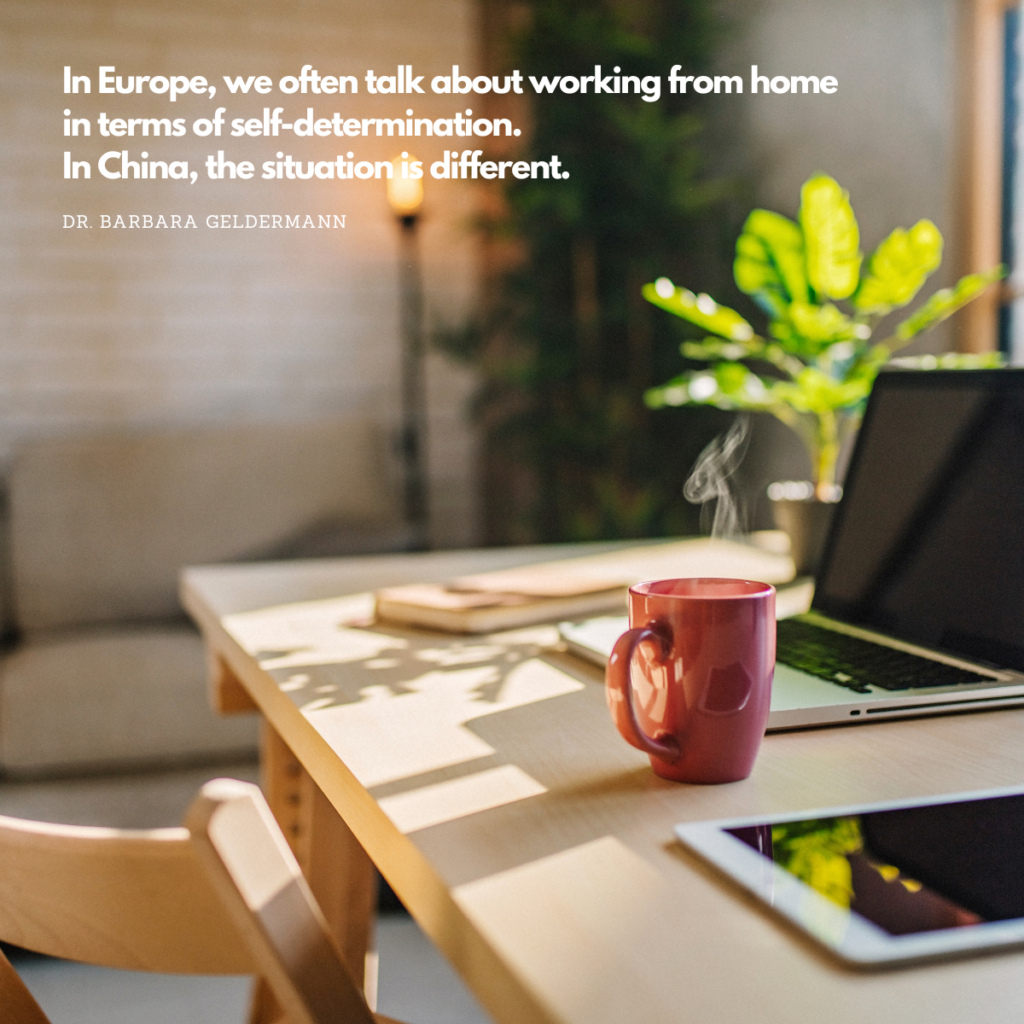
In Europe, we often discuss remote work in the language of autonomy: flexibility, work-life balance, productivity, focus, and personal responsibility. Of course, this is not without friction. Not every manager is comfortable leading people they cannot see. Not every company has truly learned how to work in a hybrid way. But in many places, home office has become part of a broader negotiation: How do we want to work and what do people need in order to do good work?
In China, the situation is different.
Not because people there are less able to work flexibly. Quite the opposite: digital infrastructure, mobile communication, and platform-based workflows are deeply embedded in everyday business life.
But remote work meets a different cultural understanding of work.
In China, presence often means more than physical attendance. It is a signal: I am available. I am involved. I am showing commitment. I am part of the collective.
Especially in more hierarchical corporate environments, visibility is closely connected to trust. Someone who is not physically present is not automatically perceived as working in a focused and self-directed way. They may also be seen as less tangible, less controllable, or less closely connected to the team.
There is another factor: many working environments in China are shaped by speed, constant coordination, and short response times. Work often happens in dense communication loops — through WeChat, calls, quick updates, and spontaneous alignment. This makes working from home technically possible, but culturally not always self-evident.
So the real difference is not simply: “Can people work from home?”
The more important question is: “What does it mean when someone is not there?”
In Europe, remote work is increasingly seen as part of modern work organization. In China, it remains much more dependent on context: industry, city, type of company, leadership style, and whether trust has already been established.
Anyone working internationally should not underestimate this difference.
Western ideas of flexibility cannot simply be transferred one-to-one. What may sound like autonomy in one context can be read as distance in another. What we understand as efficient self-organization may, in a different cultural framework, be perceived as a lack of presence.
That is why one of the most important skills in international business is not to assume that one’s own model is universal.
It is to understand the unspoken expectations behind the way people work.
Home office is a good example of this: it shows that modern work may have the same technical possibilities everywhere but not the same cultural meaning.
For professional context: Eurofound describes remote and hybrid work in Europe as still being in high demand, even though access to these options has recently declined again in some areas. At the same time, Europe is seeing a more intensive discussion around boundaries, working hours, and the “right to disconnect.” For China, current labour market and workforce data present a more mixed picture: hybrid and remote work models do exist, but they depend strongly on industry, type of company, and leadership culture. PwC data on employees in Mainland China also indicate that on-site work continues to account for a very large share of working arrangements.
Sources: