
Asia Transfer · Insights
How to say “Unfortunately, I can’t eat this” as respectfully as possible in China
Politeness Code at the Round Table
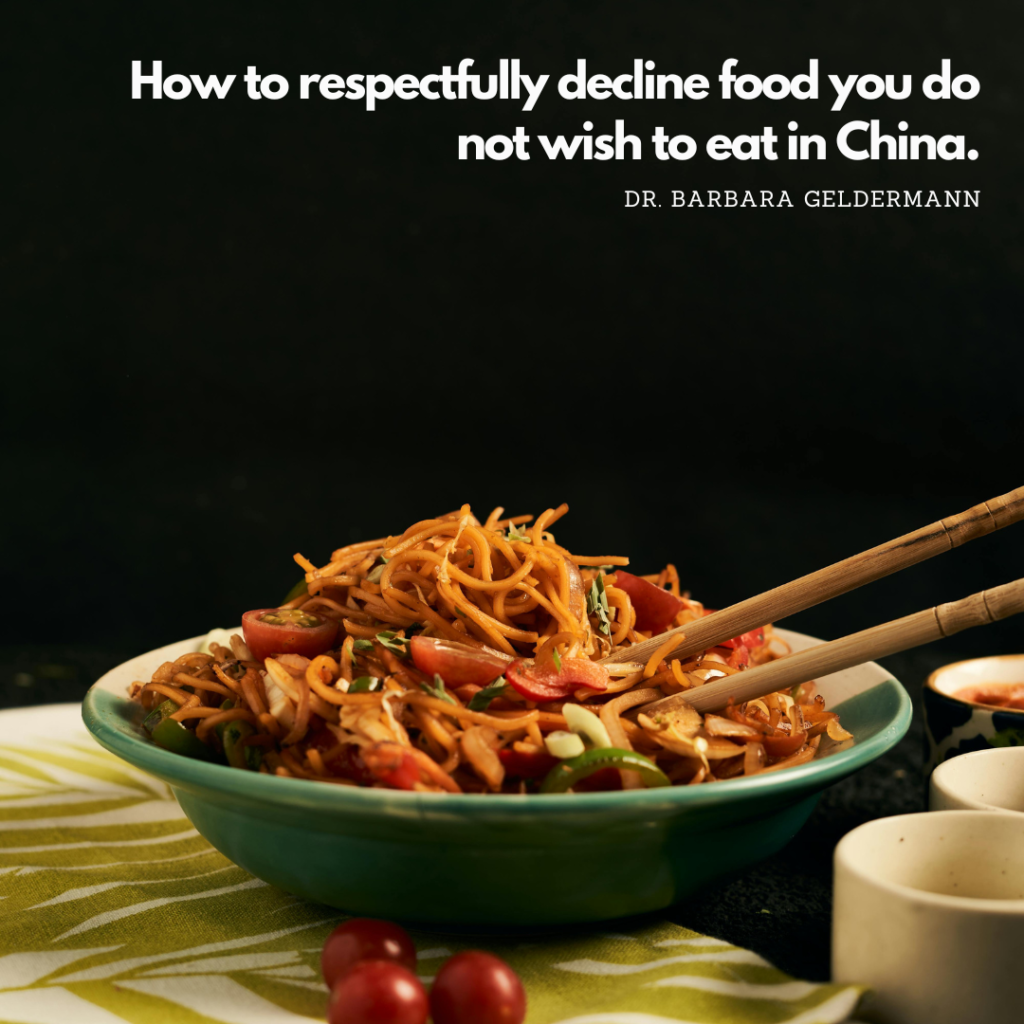
First dinner in Suzhou. Round tables, red-and-gold tablecloths, a lazy Susan loaded with specialties. Mr. Zhang smiles: “One of our delicacies—you must try it.” A bowl of duck rotates to Marie; Mr. Zhang is about to place some on her plate. She knows: a direct “no” is not about the dish here—it can quickly feel like a rejection of the relationship. At the same time, her stomach says: impossible.
So she smiles and says, “Thank you, that looks excellent. Thank you!” Then she acts as if she were eating: Marie reaches for the dish right away, takes a tiny piece, sets it on some rice, taps off the sauce, brings the chopsticks once to her mouth—only a symbolic bite follows. Mr. Zhang understands without Marie having to explain much. No problem; both sides feel seen and respected. Brief nods around the table. Mr. Zhang turns the tray and now places some vegetables on her plate. Later, Marie raises her tea: “To our collaboration.” Nobody loses face. The relationship gains.
The core principle (reliably works)
Appreciation first
Acknowledge effort and pride before you limit yourself: “Thank you, that looks great.”
Act as if
Declining works with a simple pattern: praise the dish, let a small piece be placed on your plate, but don’t actually eat it—just act as if.
If needed: health, religion, or compliance outrank taste
Brief and factual: cite “medical advice,” “allergy,” or “religious reasons.”
Follow-through/relationship anchor
Offer a toast, compliment, or short outlook: “I’m very much looking forward to tomorrow / to your recommendation.”
Practical scenarios
A) Allergy/medical
“Thank you, that looks excellent. Unfortunately, I’m not allowed to eat [seafood/peanuts/etc.]—doctor’s advice. May I have this chicken/these vegetables instead?”
B) Religion/compliance (highly respected)
“Thank you for your selection. For religious reasons, I don’t eat [pork/alcohol]. Could I have chicken/vegetables instead?”
C) Sensitive stomach/texture (without saying “I don’t like it”)
“Many thanks! My stomach reacts sensitively to [very spicy foods/offal]. Would a very small portion be okay—or I’ll choose this mild dish instead?”
D) Alcohol/toasts (sidestepping ganbei)
“I’m not drinking today (medication/jet lag). May I toast with tea? I’d really like to join you in a toast.”
Preventive steps before dinner (helps a lot)
Proactively message the organizer (WeChat/email):
“Thank you for arranging everything! A quick heads-up: I don’t eat [X] for [medical/religious] reasons. Chicken/tofu/vegetables are perfect—I’m very much looking forward to it.”
Gently guide the menu:
“I’d especially love to try your local chicken/river fish/tofu.”
Handling delicate moments gracefully
“Please, just try a little!”
“Very kind, thank you! Just a tiny bit is fine.”
“This is our specialty!” (strong pride)
“I see how special it is—thank you. I’ll gladly try a small piece.”
(You simply take very little as a signal that you don’t want more.)
Multiple hosts, lots of pressure
Bundle roles: “May I check with Ms. Chen for a moment? I’m happy to follow your recommendation.” (Creates structure; no one loses face.)
What to avoid
“I don’t like that” / “Disgusting”—devalues the host/kitchen.
Vague wellness reasons (“detox/diet”)—weaker than medical/religious grounds.
Jokes about animal species/body parts—can come across as disrespectful.
Only refusing without a counter-gesture (no toast, no compliment, no alternative)—feels cold.
Pocket cheat sheet
Appreciation: “Thank you, that looks great.”
Reason: “Allergy/doctor’s advice/religious reasons.”
Alternative: “Happy with chicken/tofu/vegetables / very small portion / mild.”
Follow-through: Short toast or compliment: “To our collaboration! / The sauce is wonderful.”
Bottom line: In China you don’t say “I don’t want this,” you say “I appreciate your hospitality—thank you.” Appreciation before clarity, a reason instead of a judgment, and an alternative instead of a blockade—this keeps the relationship strong while you stay true to yourself.